Look at the pages people visit before they fill out your contact form. On most small-business sites, About is near the top of that list, right behind the service page and the pricing page. People read it after they've decided you might be able to do the job, when what they're really trying to work out is whether hiring you will be a mistake.
And then they hit something like this: "Founded in 2015, Acme Solutions is a full-service provider committed to excellence and delivering value to our clients." Nothing in that sentence is false. Nothing in it is useful either. It could belong to any of the four other companies the reader has open in other tabs.
The About page has one job. Convert a maybe into a phone call. Everything below is in service of that.
The question your visitor is silently asking
Nobody lands on your About page because they're curious about your founding story. They land there because they're weighing risk. Will this person show up? Do they understand a situation like mine? Am I going to get invoiced for things nobody mentioned?
That's the subtext of every visit. A good About page answers it without ever naming it, by being specific enough that the reader can picture working with you.
Specificity is the whole trick. "We take pride in our attention to detail" tells a reader nothing, because no company has ever claimed the opposite. "We photograph every step of the demo so you can see what was behind the wall" tells them what Tuesday looks like. One of those sentences you could paste onto a competitor's site. The other one you couldn't.
Start with who you help, not when you started
The first two or three sentences carry more weight than the rest of the page combined, and most businesses waste them on chronology.
Open with the person you serve and the problem you solve for them. A bookkeeper might start with something like: "I do the books for restaurants and bars in the county, mostly places with one location and no full-time office staff." That's it. A restaurant owner reading it knows within a second whether to keep going, and so does the boutique manufacturer who is now free to leave and stop wasting both your time.
That second effect matters more than people expect. A page that repels the wrong clients is doing you a favor. If you don't want residential work, say you do commercial only. If your minimum project is bigger than what most people who call you are expecting, hint at the scale of work you take on. Every unqualified inquiry you deflect is an hour you don't spend on a quote nobody was going to accept.
Put a real person on the page
People hire people. Even when they're hiring a company, they're picturing a person, and if you don't give them one they'll invent a worse one.
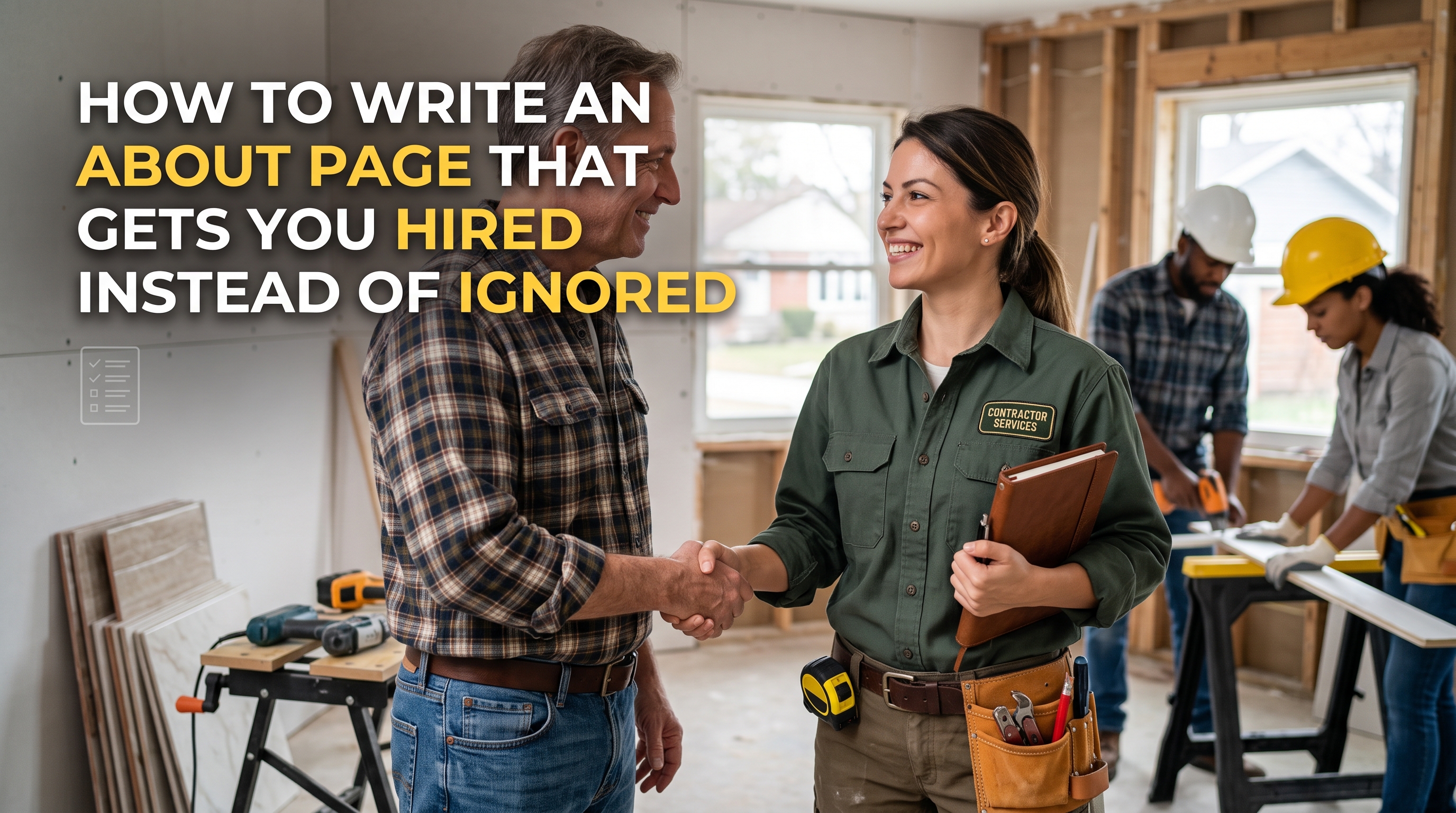
So use a photograph of yourself or your team. Not a stock image of models in a bright office, and not a logo where a face should be. A clear, well-lit, unfussy photo of the actual humans. If you're a solo operator, a photo of you in your work clothes, in the place you actually work, beats a studio headshot with a gray backdrop. It reads as true because it is.
Use first names. Say who does what. If there are three of you, say which one answers the phone and which one shows up at the site. Buyers are trying to build a mental model of what dealing with you will feel like, and names and roles do that work faster than any adjective.
Write in the voice you'd actually use. If you're a one-person operation, write "I," not "we." The royal we fools nobody and it makes you sound like a call center. Being small is not a weakness you need to disguise. Plenty of buyers are on your site precisely because they got tired of being account number four thousand somewhere else.
Facts beat adjectives, every time
Here's the substitution to make throughout the whole page. Wherever you've written a quality, replace it with the evidence for that quality and delete the quality itself.
"Highly experienced" becomes the number of years you've been doing this, or the kind of work you've done most of. "Reliable" becomes your actual policy: you call back the same day, or you don't start a job until the previous one is finished. "Trusted by local businesses" becomes the name of a client who said you could name them.
Credentials belong here too, and small businesses undersell these constantly. Licenses, certifications, insurance, trade association membership, the manufacturer training you sat through. If a customer would have to check it before hiring you, put it where they can find it instead of making them ask.
Same with anything that sounds unusual. The former career you left. The equipment you own that competitors rent. The one thing you're known for locally. Odd, true details lodge in memory in a way that polished summary language never does.
Say what you won't do
This is the part almost everyone skips, and it's the part that builds the most trust.
Name your limits. A designer can say she doesn't do logos. A contractor can say he doesn't take on jobs he can't personally supervise. A consultant can say she works with two clients at a time and there's often a wait.
Admitting a limit reads as confidence, because only someone with enough work turns work away. It also signals that the rest of what you've written is honest, since a person willing to state a downside is more believable on the upsides. And practically speaking, it saves you the conversation where somebody wanted something you were never going to provide.
You can do this without being negative. "I don't do emergency callouts, so if your heat is out tonight, call someone else and I'll be happy to look at the long-term fix next week." That's helpful, honest, and it makes you sound like someone who knows exactly what he's for.
The story part, kept short
Origin stories can work. They just have to be short and they have to connect to the customer's problem.
The test: does this detail explain why you're good at this, or why you care about it in a way another provider might not? A cleaner who started the business after years of cleaning hospital wards has a story worth two sentences, because it explains a standard. A cleaner who "has always been passionate about helping people" has nothing, because passion is unfalsifiable and everyone claims it.
Cut the sentence about growing from humble beginnings. Cut the mission statement. Cut anything about being committed to excellence, because there is no company anywhere committed to mediocrity, and the reader knows it.
One short paragraph of story is plenty. Two if the story is genuinely unusual.
End with the next step, not a full stop
A lot of About pages stop dead once the writing runs out. The reader has just finished deciding they like you, and the page hands them nothing to do with that feeling.
Tell them what happens next in plain terms. Not "contact us today," which is furniture. Something like: "Send me a note about what you need and I'll reply within a day with either a rough price or an honest referral to someone better suited." Describe the first step, and describe it in a way that lowers the cost of taking it. Most people hesitate to call because they're afraid of being sold to. Tell them what the call is actually like.
What to do this week
Read your current About page out loud and mark every sentence you could paste onto a competitor's site without changing a word. Delete all of them. What's left is your real page, and it's probably four sentences long, which is fine, because four true sentences outperform four hundred generic ones.
Then rebuild around those four. Who you help, what you actually do, who you are, what happens when someone reaches out. If getting the page live is the part that's been stalling you, sitejourney.ai handles that side so the writing is the only thing left to do.
One more pass afterward: hand the page to somebody who doesn't know your business and ask them to tell you, in their own words, what you do and who for. If they can't, the page isn't finished, no matter how good it sounds to you.